ONE:So close were they upon King Joseph, that a party of the British, under Captain Wyndham, came upon him in his carriage, and fired through the window. Joseph had the good fortune to escape to horse, and gallop off, but his carriage fell into the hands of the British, and it was found crammed with the most precious spoil of the churches and palaces of Spain. Amongst his baggage, which also was taken, were found some of the finest paintings of the Spanish masters, rich plate, including a splendid dinner-service, a gorgeous wardrobe, and a number of his women, for he was a perfect Sybarite in luxury and voluptuousness. No such scene was witnessed, except on the defeat of some Eastern army. The officers had gorged themselves with the spoils of Spain, and here they were left, amid crowds of wives and mistresses, monkeys, poodles, parrots, silks, satins, and jewellery. The officers and soldiers had run for it, with nothing but their arms and their clothes on their backs, and all along the roads leading from the city was one vast crowding, jostling mass of waggons, loaded with all sorts of rich spoils, splendid dresses, and wines, and money, and fine ladies in the most terrible hurry and fright. Sheep, cattle, lambs, like a great fair, were left behind, and became the booty of the pursuers. There was a vigorous bursting open of packages, and rich wardrobes of both officers and ladies were soon fluttering in the winds¡ªgorgeous uniforms on the backs of common soldiers and Portuguese camp-followers¡ªfine silks and satins, and laces and gold chains, on the persons and necks of common women. The military chest was seized, and the soldiers freely helped themselves to its contents. Lord Wellington says that the troops got about a million of money. Planks were placed from waggon to waggon, and a great auction was going on everywhere, the lucky captors converting everything possible¡ªeven the heavy Spanish dollars¡ªinto gold, as more convenient for carriage. The inhabitants of the city made rich bargains, besides managing to help themselves plentifully in the scramble.
TWO:LA ROCHE-JAQUELEIN AND THE REPUBLICAN SOLDIERS. (See p. 444.)[596]
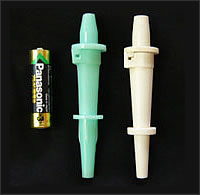
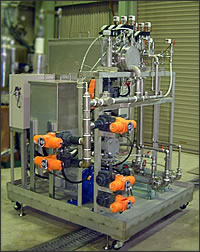
A hydrocyclone (liquid cyclone) injects treatment solution into stationary equipment to perform separation, classification, and concentration, and is an innovative separator with a very simple structure and no drive unit.
Structure of a hydrocyclone (liquid cyclone)
A suspension containing fine particles of several micrometers or more is supplied to a cylindrical container circumferentially at high speed. And as a result it starts to rotate and a centrifugal force is generated. At this time a gravitational acceleration of several tens of thousands of G is generated in the circumferential direction, and thus leading to fast sedimentation and concentration of the fine particles. The separated concentration can be freely selected by changing the supply rate (supply pressure and flow rate) and the flow ratio of the outlet. Our hydrocyclone (liquid cyclone) was designed and manufactured to classify and concentrate fine particles, and so has a small element.
THREE:On the 28th of March the Ministry, as completed, was announced in the House, and the writs for the re-elections having been issued, the House adjourned for the Easter holidays, and on the 8th of April met for business. The first affairs which engaged the attention of the new Administration were those of Ireland. We have already seen that, in 1778, the Irish, encouraged by the events in North America, and by Lord North's conciliatory proposals to Congress, appealed to the British Government for the removal of unjust restrictions from themselves, and how free trade was granted them in 1780. These concessions were received in Ireland with testimonies of loud approbation and professions of loyalty; but they only encouraged the patriot party to fresh demands. These were for the repeal of the two obnoxious Acts which conferred the legislative supremacy regarding Irish affairs on England. These Acts were¡ªfirst, Poynings' Act, so called from Sir Edward Poynings, and passed in the reign of Henry VII., which gave to the English Privy Council the right to see, alter, or suppress any Bill before the Irish Parliament, money Bills excepted; the second was an Act of George I., which asserted in the strongest terms the right of the king, Lords, and Commons of England to legislate for Ireland.
Equipment costs can be reduced.
Operating costs can be reduced.
Maintenance costs can be reduced.
Any change in raw material and product can be easily addressed.
Large amounts can be treated in a small area.
Separation and cleaning are easy because of the simple structure.
Simplified control
This equipment can be operated in synchronization with external devices.
Alarm and interlock mechanism.
THREE:As soon as Parliament assembled, Earl Grey in the Upper House, and Lord Althorp in the Commons, stated what the intentions of the Government were with regard to the Reform question. Earl Grey announced that they had prepared a measure which had met with the entire, the unanimous concurrence of the whole of his Majesty's Government. The measure was to originate in the House of Commons, and Lord Althorp intimated that the duty of introducing it had been entrusted to the Paymaster of the Forces,[330] Lord John Russell, though not then a member of the Cabinet. This was done because they thought it no more than due to his long perseverance in the cause of Reform in times when it was unpopular. When it was difficult to obtain a hearing upon the subject, he had brought forward plans of partial Reform, and now that the cause was prosperous, they deemed it due to his perseverance and ability that he should be the person selected by the Government to bring forward their plan of full and efficient Reform. The measure was to be introduced on the 1st of March.The Reformers made repeated and strenuous efforts to obtain a parliamentary expression of the desirableness of this country refraining from interfering with the internal affairs of France, and of making specific arrangements with that country. Earl Stanhope made such a motion in the Lords[441] on the 6th of January, and the Duke of Bedford made a similar one on the 27th of February. Lord Grey had moved the same thing on the day before, but all these endeavours were rendered abortive by Pitt's standing majority. It was replied that France had no government that could be treated with, and Lord Mansfield asserted that we had a right to interfere in the internal affairs of any country that acted on principles dangerous to its neighbour. Fox, on the 24th of March, moved for a committee of the whole House to inquire into the state of the nation, but this was rejected on the ground that the times were too critical, and Canning adduced the condition of Ireland, just on the verge of rebellion, as a sufficient cause for not ascertaining our actual state.
Classification and concentration for the manufacture of inorganic powder materials
Classification of ceramic materials
Removal of fine particles, including iron powder
Removal of fine particles from pigments
Removal of fine organic particles from solvents
Separation of starch and yeast
Removal of fine particles from high-temperature strong acid solutions
Removal of fine particles from low-temperature solutions